














Most recruitment agencies have dyed in the wool processes that have slowly evolved over decades. Chances are, they’re the same processes that you, your founder, or members of senior management used when they were billing.
They’ve travelled from previous companies, ‘best practice’ routines from historical success metrics, or simply follow the recruitment rule book, handed down by past bosses.
Does that make them fit for purpose in an ever-evolving world? Maybe today, but what about tomorrow?
How often should you sanity-check these processes? And how can you evolve with the market, rather than get left behind?
In and amongst your marketing, you’ve probably used the term “we’re a little bit different” at some point.
But are you? Or are you following the same steps as your competitors? With little differentiation in process?
When was the last time you explored hidden bottlenecks, silos or assessments which might be out of date?
Because if you let this happen without redress, you can quietly erode both your margins and reputation.
To what extent do you evaluate the candidate experience you give to the market? Do you explore your net promoter score?
How much emphasis do you place on reducing your time-to-hire, cost per hire and improving your quality of hire?
To stand out to clients with a better delivery model than your competitors, you need data.
And then the drive to improve your systems and processes, on the back of that data.
Today, we’ll discuss how you can do just that.
Signs your process is going stale
In some recruitment businesses, the writing’s on the wall.
Normally that’s the company’s core values, but occasionally, the team’s deficiencies join them. But where problems are more hidden, and spotting them is difficult, they can be disguised as other problems.
Recruiter performance reviews with individual managers tend to focus on placements, revenue and perhaps personal contentment and performance.
Sign no: 1 - ‘Time to hire’ is one of those benchmarks where multiple players are responsible.
It could be an individual hiring manager, interviewer, the candidate dragging their feet or indeed, recruiter performance.
But if two placements at similar companies take wildly different times, process is the likely cause. How often do you look at this? And to what extent are your recruiters benchmarked on this?
Clients that hire quickly are normally happier clients. Of course there are outliers, where a client will ask to keep a candidate warm for what seems like months. But that’s just as useful data as a client that hires within days.
Should your recruiters be prioritising a placement that takes over 2 months? Would a supplier of a different kind, say software sales, continue to work with them? Or move on?
Sign no: 2 - Low or falling candidate NPS, is another strong benchmark to look out for.
If the raw data tells you one side of your business isn’t happy with the service from your recruiters, you’ll need to analyse in each case why that’s happening.
It could point to poor communication, slow feedback, or clumsy interviewing. Of course, it might not be your recruiters’ fault directly. Maybe it’s the quality of roles or clients? Even the ability of the individual hiring manager?
You won’t know until you have the data to guide you.
Sign no: 3 - Recruitment data is kept in isolation or secret spreadsheets.
Back in your day you’d call this ‘top drawing’. Today it’s perhaps less prevalent, given the digital way of business.
But it still happens. How much does it happen in your business? Because it’s a problem if you don’t know the answer.
If your consultants each hold their own candidate data, you have silos. Make no mistake, this will lead to duplication, poor forecasting and inconsistent candidate experiences.
You’ll probably have competing teams in your company too. How frequent is one team blaming another or giving them poor handovers?
This is essentially a cultural silo. Their competition is great for day-to-day battles and geeing up the masses. But they are, despite what you tell them, on the same team.
And finally sign no: 4 - high variance in offer acceptance rates or candidates leaving quickly.
This could be a sign of bad role definition, overpromising and underdelivering, or poor selection process.
None of these red flags will be waved from the rooftops, and might escape your immediate attention. But they’re early warning signs an improvement in your process is greatly needed.
So how often should you analyse your data?
It’s incredibly difficult to improve anything you can’t measure.
Luckily for you, everything your team does is measured. The good, the bad and the ugly.
Oh and if it’s not, it should be.
But there’s a stipulation here, on the processes you analyse, and how suitable they are for improvement. Here’s a rough guide on what recruitment business leaders like you might look at.
1. Daily & weekly process improvement opportunities
Monitoring your core KPIs and dashboards is something you’ll probably do by the minute.
You should also be looking at time-to-fill, pipeline, offer acceptance rate, and candidate NPS.
Dashboards help you spot sudden deterioration early, but digging into the reasons behind these numbers will elevate your future improvements.
Candidate NPS scores are something very few recruitment businesses perform. But they’re a huge part of your success, and your clients’. And in today’s business landscape can alone be the differentiator between one-off roles and long-term repeat business.
A true consultant will be advising a client with a poor candidate experience on the benefits improving it will have. Are yours?
2. Quarterly improvements
Most recruitment business leaders, including individual managers look at the quarter just gone, with a simple outlook: “did we make as much money as expected?”
If a team’s projected output is 30 placements, and a specific financial figure, it becomes a game of ‘higher or lower’.
But quarterly reviews should be a chance to look more operationally at the wider picture.
This might mean formal operational reviews, examining funnel conversion rates, hiring manager satisfaction, source ROI, and interviewer calibration.
Can you look at two recruiters doing things dramatically differently, in different markets, and see where one could improve by imitating the other? A/B test job ad wording? Job ad placement? Technical assessment efficacy or impact on hire retention or candidate NPS?
If your quarterly reviews are solely monetary, and don’t look at process, you already have a glaring opportunity to improve your team’s performance.
3. Annual improvements
As the end of your calendar, or financial year draws nearer, it’s likely you’ll view the whole calendar as a whole and assess your company’s performance.
This moment is the perfect time to look at a strategic evaluation, evolution or even redesign.
Analysing what worked, and what didn’t shouldn’t solely be around individual performance. One person doing well, and another not, doesn’t necessarily mean one recruiter’s able and the other isn’t.
Of course ability plays into it, but what are the actual processes that are working? Is it specific to the market? Something in their approach to candidates? How do they engage clients? The amount they’re meeting their network face-to-face?
And how much are these elements ingrained into the fabric of the process? To what extent do teams differ in approach? Or even recruiters on the same team?
How much does your tech stack help or hinder your processes?
And how much do other parts of the wider recruitment or hiring process? Topics like employer branding might seem like they’re on the periphery, but play a big part in success.
4. Ad-hoc red flags
One recruiter in your team having a ‘donut’ or non-billing month is a little too obvious to point out as a red flag.
But even that doesn’t tell the whole story. Why did it happen? How can you stop it happening next time? Are there reasons, other than a lack of effort?
Ask your recruiter directly and they’ll tell you as such. But there are likely micro-red flags that you can spot before a ‘no placement month’ rears it ugly head.
A negative shift in KPIs is obviously one of them.
It could also be a sharp fall in time-to-fill. A dramatic fall in candidate NPS scores.
Even a sudden increase in offer rejections.
But looking wider can also highlight some red flags to inspire action.
A shift in market conditions for example. Recruiters, in my experience, often don’t struggle to shift markets fairly quickly. Even on a small iteration.
And so, mass layoffs or regulatory shifts should be heeded well before they impact your team.
As should new tools like gen-AI screening, chatbots or any other technological advances.
And each of these should warrant a discussion at the very least. In most cases evolution too.
How to OneUp your team
A fool-proof method for spotting bad processes, or activities that might turn into a revenue dip is using the right technology.
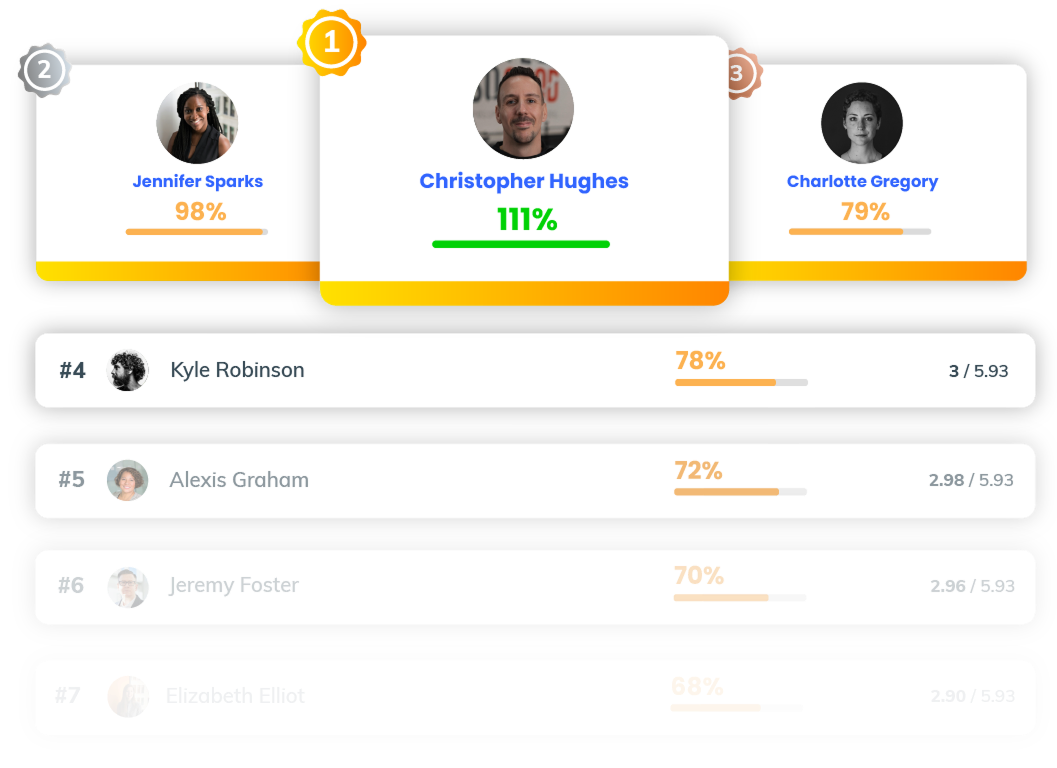
OneUp helps recruitment companies visualise their team’s efforts in a way that’s as easy as looking at a TV.
You can increase productivity, fill more jobs, identify more top candidates, increase BD activity or just create a single source of truth across your teams.
Activities you can build process around to evolve with the market and your competitors.
To learn more about what we can do to help your recruitment business stay with the times, click here and book a chat with our team.