














It’s easy to think the recruiters in your business are solely money motivated. You’ll have no doubt used this as a benchmark to gauge whether you hired them or not.
Those who’d worked in sales previously, or competed to a high level in sports showed commitment to bettering themselves, and the competitive spirit they need to do well in their career.
But are they actually just money-hungry? Does a fat commission cheque every month mean they’re eternally happy? Or is there a wider consideration to be made in retaining your best people?
Is it really not just money?
The fact is, if the recruiters in your business weren’t motivated by money, you wouldn’t have employed them. After all, there are plenty of easier jobs to do for a basic salary. Ones without the stress, dizzying highs and crashing lows this game has. Even the strongest characters can falter when times get tough.
Famine follows feast all too often. So why take a chance on someone without the killer instinct? Chances are you don’t, and haven’t.
Equally, there’s likely to be very few people in your business who do what they do out of the kindness of their heart. Sure, the pleasure of seeing a candidate’s smiling face when they get their dream job is nice. But that warm fuzzy feeling doesn’t pay the bills.
So, I’d say with 99% certainty, the recruiters in your business are motivated by money. But there are caveats to this fact. Limitations even. And most of the time, it will come down to an equation as follows…
Happiness = reward - toll
The problem with this equation
The problem with this equation is that happiness is transient. It changes. Evolves. On a basic level, many argue you probably can’t achieve full happiness without experiencing the opposite occasionally.
Which is both confronting and reassuring when you hire and manage people. And their success defines yours. But if we assume happiness, regardless of how elusive it can be, is the target, and that largely happy people don’t leave jobs, all you need to do is increase their reward and limit the toll it takes to see it.
So, I should increase our commission scheme?
There’s a surprising amount of secrecy in recruitment on commission schemes. Very few businesses publish their rewards publicly. Even job ads, where the primary and sole intention is to attract new recruits, rarely detail the true compensation on offer. It’s all “OTE”, or “competitive”, or “generous” even if there’s a vague number attached.
Why this is, I’m not sure. Every single recruitment business knows the commission scheme of their competitors. As do Rec2Recs and senior recruiters at other businesses.
But those with the best commission schemes aren’t necessarily the most successful businesses. And those who pay more aren’t necessarily better businesses, either in terms of internal hiring, or commercial success. However, those businesses that give their people the capability to earn more money, hire better people and are more successful. It’s a self-fulfilling prophecy.
While a good commission scheme alone doesn’t guarantee you great hires, a bad one might guarantee you’ll make none. Looking at the equation above, if the effort needed to make money increases, and the reward diminishes, happiness levels will likely plummet.
Of course ‘toll’ is an intentionally flimsy description. That toll might mean:
- Hours worked
- Stress levels
- Office drama
- Sheer physical and mental effort
One way to increase reward is to improve commission. Another might be just recruiting in a more financially rewarding industry so the same work pays off more greatly. It might mean better training, or a more cohesive team.
The wider picture
If financial performance is such a large driver in success for recruiters, and a commission scheme alone isn’t the be all and end all, what other factors are at play?
This is something we discuss in a recent podcast with Nathan Fuller (MD, Kite Human Capital) and Donna Owen (Fractional CRO, Firefish | ex-Vincere), which you can listen to here.
Firstly, it’s the likelihood of a recruiter actually earning that commission.
There’s a whole host of elements that play into that:
- The market, niche, or specialism
- The skill level and training of the recruiter
- How supportive senior management is
- The economy and your professional brand
- Location and office culture
There’s a very strong argument that wider purpose is the one thing which motivates recruiters more than anything. As Nathan Fuller points out, that purpose will be different for each individual. Happiness is largely how much their job facilitates that specific purpose.
Mental stability
You’ll have benchmarked someone’s drive and capacity for overcoming diversity in their first interview. But this isn’t a ‘one and done’ calculation. Stress (or toll) can have a compounding interest in someone’s career.
In times gone by, you’d insist a recruiter operating at 50% comes in to work. These days it’s perhaps less likely. As you’ll already know, stress and negativity can be caught by others. You’ll also know a top biller who unsettles the rest of your team often isn’t worth the risk. If them being there risks the majority becoming unsettled, it’s simply not worth it.
What are you doing to maintain mental stability and fortitude on an ongoing basis for each person you employ? Do you know whether they’re happy? Do you know what would make each person happy?
Smaller competition
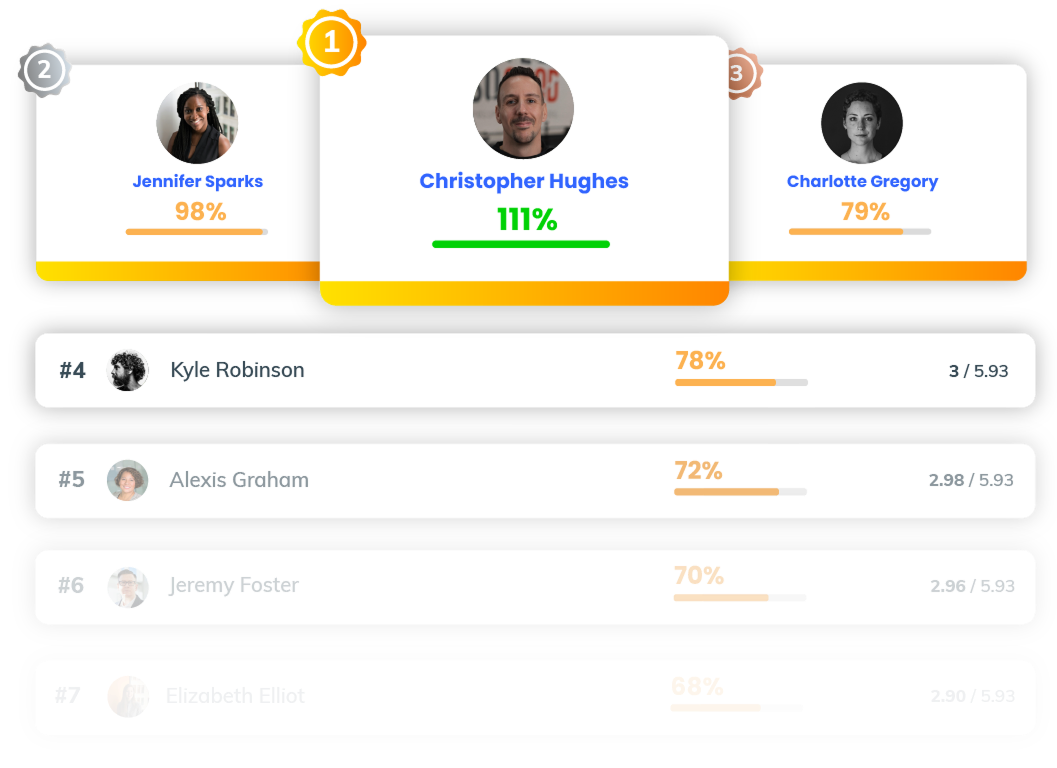
The technology on offer from OneUp helps recruitment businesses like yours set daily, weekly, monthly and annual competitions between teams and individuals. We have entire setups dedicated to this cause, with TV projections that keep your recruiters informed by the second on where they stand against their colleagues.
But many stop short of simply offering that financial uplift straight back to their consultants, without first thinking how best to present it. There are extra holiday days, early finishes, shopping vouchers, and a whole host of rewards on the periphery of financial reward.
The key to making sure your recruiters perform is knowing what motivates them. Every recruiter in your business will be money motivated to a degree, but there are some things money can’t buy. Like time with their family, attending their children’s Christmas play, or just taking extended holidays without negotiation or guilt.
Happy employees rarely leave. The question is, what makes your people happy? Because if you know that, on an individual level, all that’s left to do is offer it to them.
Watch the full episode of OneUp Sessions: ‘Driving Success: Motivation That Lasts’ on YouTube here.