













We wrote recently about the problem of coaching in recruitment.
If you missed that article, read it here. I spoke about how ultimately, coaching in recruitment leaves a lot to be desired.
One-to-ones might be frequent but far too inconsistent in promoting a culture of consistent improvement. While follow-up actions simply don’t tend to happen.
On the tech side of things, all most current tools do is create a greater admin burden for your people, failing to drive accountability for those in your business.
And recruitment managers are overwhelmed, frustrated and overloaded with manual tasks that distract them from their purpose, rather than helping them.
Accidental managers
It’s no secret in recruitment there’s a swathe of accidental managers that become incumbents of others’ performance.
Do well and you’ll become a top biller. Top billers know what they’re doing. They know how to make money, how to bring in and develop business, how to manage accounts and are usually great at managing candidates and processes.
Does that make them great managers? You already know the answer.
And it’s normally not the case. Though that depends entirely on the individual.
Expecting them to be able to manage, coach and inspire others, while also running their own financial performance without a dip is folly.
No one can suddenly take on a team while maintaining their own desk. At least not to the same degree. For many it’s a question of what’s more important.
Securing the revenue of your best performer, or taking a risk it’ll suffer, while increasing the performance of others not yet established.
If you’ve gone down this path, and I’d be surprised if you haven’t, regardless of the impact on your financial performance, the result is normally inconsistent coaching.
And inconsistent coaching brings inconsistent results.
So how can you systemise coaching without losing the individuality that drives performance?
Fighting inconsistency
Output’s measurable in recruitment. CV submissions, interviews and placements all point towards the holy grail of benchmarks… revenue.
But coaching quality, by its very nature, is far harder to measure. It’s also harder to standardise beyond entry level grads, as we talked about here.
Research around the topic consistently shows coaching effectiveness varies significantly depending on delivery quality, personalisation and consistency.
According to this report from The International Coaching Federation (ICF), 86% of companies find sizable ROI from coaching.
But specific outcomes can vary greatly depending on the structure of the process and the way it’s measured.
Meanwhile, this report from Gallup on management performance shows managers account for up to 70% of variance in “team engagement”.
This naturally impacts both productivity and profitability to extreme levels. Simply put, if there’s a ‘good’ manager or coach in place for your recruiters, you have a much higher chance of that coaching being productive.
Of course that may hinder their own financial performance. And the term engagement covers all manner of sins. You might well have “engaged” recruiters in your team, who offer very little in terms of billings.
In recruitment, where performance volatility is already high, inconsistent coaching compounds that variance.
When a top biller becomes a manager, they often coach others in their own image. Meaning they regurgitate the activities that work for them.
They also often struggle to pander to personalities different to theirs. So you’ll find confident, bolshy top billers have little time for quieter, tactile juniors. And vice versa.
But more than this, they might lack insight into performance gaps and how to bridge them. They’ll also rarely look at the bigger picture with an impartial lens.
The solution to this has to be structured, individualised, data-informed coaching.
So what solutions are there on the market?
The market for data-driven coaching tools has developed in recent years.
Tech can definitely help accidental managers and those who manage them.
Here are some tools you might consider to help coach, develop and inspire your recruiters…
1. Conversation intelligence & call analytics
Having a real life human manager listen in to a recruiter’s call is sooooo 2014.
It’s also one of the most time-consuming activities you can think of, and basically means doing the work twice.
However there are now tools on the market that can do this for you.
Platforms such as:
These tools can analyse the conversations your recruiters have daily, and critically assess their ability to handle objections. They’ll also give you the ratio of talking to listening and recognise follow-up patterns and sentiment… and whether they’re acted upon or missed.
Here’s an example of the type of insight you could garner by using one of these tools.
“On 72% of your BD calls, pricing was introduced in the first 3 minutes, and close rates dropped by 18%.”
Rather than…
“I’d have not called him mate in the first 10 seconds and I’m definitely better at sales than you.”
Which, OK, might be reductive, but highlights why technology might be better for analysis of sales patter than a human.
Ultimately using data in your coaching can transform subjective feedback into objective development.
This research from McKinsey highlights exactly that.
Pointing out companies that use advanced analytics in sales typically significantly outperform those that don’t, in both revenue and productivity. Two components of a recruitment business fundamental to success.
2. Performance management and coaching platforms
There’s performance software now which can help managers track behaviour, not just results.
Examples include:
- Coach, from OneUp (naturally)
- Lattice
- 15Five
Recruiters who see more, place more. By 43% actually.
Coach is a new product for us. And we’ve been delighted by the interest from our existing clients, some of which are trying it for free as we speak.
Where platforms like Lattice and 15Five allow 1:1 tracking, personal goal setting, structured development plans and ongoing feedback loops, Coach goes even further and is targeted solely for recruitment businesses and accidental managers.
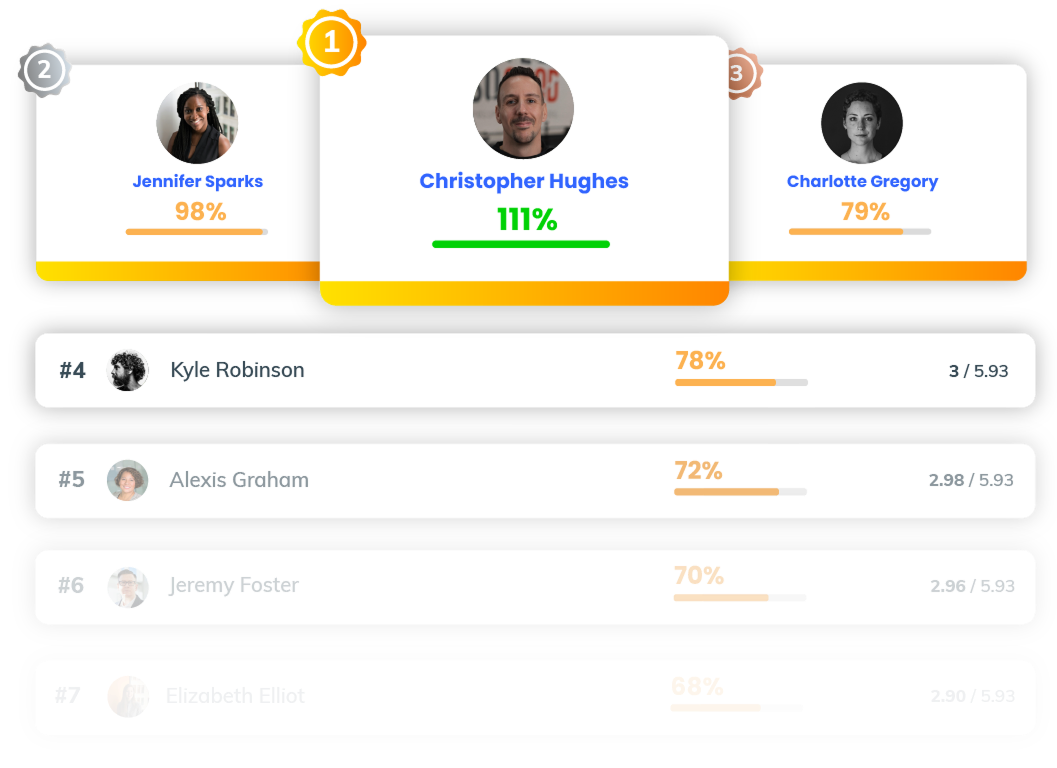
Coach shows new and "accidental" managers what to coach and when.
- It uses AI manager briefings to give you a clear, neutral snapshot of performance, progress and recommendations before each meeting - all in one click.
- It allows you to run consistent, target-driven 1:1s without reinventing the meeting.
- Ready-made performance insights to help you get the right metrics automatically.
- And a complete audit trail so every meeting, goal update and action is logged for you, without the admin.
It’s our belief that coaching and development in recruitment is mainly a systems problem.
- Managers spend hours manually prepping for meetings.
- Actions are discussed verbally, then forgotten by Monday.
- Coaching stays high-level instead of focusing on specific target gaps.
- Performance slips because there's no single source of truth.
We’re changing that, and giving your top billers, managers and directors heightened ability to manage their teams, whilst taking away the admin involved on other platforms.
It also helps your recruiters make more money. And given they’re the cogs in the machine of your business, is probably the most persuasive reason for using Coach.
After all, the better your recruiters perform, the better your business.
3. AI-assisted coaching
AI can now provide:
- Automated call summaries
- Personalised coaching suggestions
- Behaviour trend analysis
- Skill gap identification
This research from Harvard Business Review documents how AI can augment your human recruiters' coaching and help you identify blind spots far quicker than a human can.
Ironically, using blanket tools like AI can make your coaching individualised and scalable.
Because it gives detailed feedback that’s specific to the individual, rather than generalised advice that doesn’t suit the person and their specific problems.
So, what’s the solution to coaching in recruitment?
- Separate billing from coaching metrics
- Give managers coaching frameworks, rather than targets
- Use behavioural data
Recruitment has, and always will be an industry built on individuals. That’s why it’s important your recruiters can “build a business within a business”. It’s also why you put non-competes in your peoples’ contracts.
And why they’re routinely ignored or worked around.
Businesses work with individual recruiters. Far more than they work with recruitment businesses.
Because of that however, there’s never been a suitable solution for coaching teams of recruiters that doesn’t let some fall through the cracks.
The accidental manager problem isn’t going anywhere. Your best people are the best because they know what works, and could recreate their success from scratch tomorrow.
Your best available solution to improving your coaching is all about how you arm those people. What tools you give them. How you benchmark them. And how you reward them.
If you can systemise your coaching, using data to personalise your development and mixing technology with human guidance you’ll be one step ahead of the chasing pack.
It’ll also help you retain your best recruiters. And in an industry plagued by attrition, this might be the secret sauce to growth in an uncertain economy.