OUL Logo - Black SVG

Your go-to hub for recruitment industry benchmarks.

 
Explore insights ➜
Top rated in all the right places G2 rating
G2 Badges Staggered Tiles

“OneUp has become indispensable, empowering our team leads to make data driven decisions.”

Richard F. 100px
Richard F.

CEO | ★★★★★

Product

Integrations

See all Integrations

Make performance visible, engaging and motivating. Book a demo products1

Resources

OUL Logo - Black SVG

Your go-to hub for recruitment industry benchmarks.

 
Explore insights ➜

Company

Top rated in all the right places rating
award

“OneUp has become indispensable, empowering our team leads to make data driven decisions.”

Richard F. 100px
Richard F.

CEO | ★★★★★

Make performance visible, engaging and motivating. Book a demo

Build vs Buy: Should Recruitment Teams Build Their Own Software?

Thinking of building your own performance dashboard? See how build vs buy compares on cost, CRM integration, security and key-person risk.

Table of contents

AI coding tools like Claude Code have made building software feel easier than ever. And each AI company is competing to get your business in a race to the death. They want your time, your money and your motorcycle.

But it’s not necessarily a doddle to build a piece of software that’s robust enough to handle your team’s requirements, without consistent effort and oversight to make sure it works without issue.

Many recruitment and sales leaders are now asking themselves why they’d pay for a platform when they could build one themselves.

And the truth is, that might be the right call.

But it also might be an expensive, risky and time-consuming distraction from the work that actually makes you money.

This article sets out the positives and negatives of each option so you can decide which is best for you and your team, with the facts laid out in front of you.

Why is build vs buy back on the agenda?

A few years ago, building your own reporting tool or CRM add-on meant hiring developers.

It probably meant hiring one full time as the initial development is just the start. Software, by its very nature, is never a one-and-done project.

Today however, someone with no coding background can connect an AI tool to a CRM and have a basic dashboard in an afternoon.

In our conversations with recruitment and sales businesses, we tend to see 3 distinct groups.


  1. Small firms (roughly 1-10 people): an MD experiments with AI tools and tries a DIY build, often without seeing the complexity underneath. One prospect used AI to build their dashboards because it was “cheap” and "good enough". Then came reporting day, and they realised the AI had invented records that mirrored their CRM data so closely that no one had noticed.

  2. Mid-sized firms (60+ people): one or two technical people can start a project, but maintaining and expanding it can turn into an all-consuming internal role.

  3. Larger firms with established tech teams: they already build internal tools and will keep doing so, just faster. They also tend to be more mature buyers who understand when purchasing makes sense.

The case for and against building

Advantages to building your own software

Building your own software does have real advantages.

  1. A tailored fit. The tool can match your workflows and business, rather than asking you to adapt to someone else's. You can build the exact thing you want, without paying for things you won’t use.

  2. Control. You decide what gets built, and when.

  3. Low entry cost. A basic proof of concept can cost relatively little in tooling, although poorly guided projects can run up much larger bills.

  4. Ownership of what makes you different. If something is genuinely unique to your business, owning it can make sense. Build what differentiates you, buy everything else.

Drawbacks of building your own software

Building the first prototype is the easy part.

A typical DIY journey can look like this:

  1. Basic connection. You link an AI tool to your CRM's API and pull some data. It works at surface level.

  2. Limits and storage. You hit API rate limits, dashboards break, and you now need to store and secure data. There are often hidden costs and AI companies bill at will, with an invoice often difficult or impossible to question.

  3. Undocumented quirks. Real-world bugs appear, such as an API returning records in an inconsistent order, which an AI tool might not know how to fix. You’re on your own here. There’s typically no help desk or human to ask.

  4. Maintenance. The person building might well run out of knowledge and ask to bring in a developer or agency, meaning there’s a cost and complexity similar to buying, sometimes even greater.

AI is good at writing code. It's far less reliable at designing systems that stay stable as data, users and integrations grow.

Security and data protection

Recruitment systems hold candidate personal information, client contacts and deal pipelines. That’s why they exist.

Nearly half of UK businesses (43%) reported a breach or attack in the past year, and phishing by far is the most common type. For a small agency, a single breach could be existential.

It’s important to remember that If you build, you take on responsibility for access controls, backups, patching and incident response. The NCSC's small business guide is a good place to see what that involves, and the ICO's guidance explains your UK GDPR obligations on security of processing.

Access to data is getting more expensive

Many builds assume API access will stay free. That assumption is very likely short-sighted. Predominantly due to the huge investment AI is benefitting from, with those behind it almost certainly wanting a return at some point. Investors rarely give money out of the kindness of their heart.

Xero, for example, moved developers to tiered, usage-based pricing from March 2026, a change that drew criticism from some developers. We're also hearing from clients that other platforms are restricting or beginning to charge for API access. This is something that’s likely to be adopted by more platforms, if not every one of them, in the future.

Key-person risk and maintenance

One operations lead we spoke to, a former software developer, had built a commission system in-house, then moved to a bought platform because relying on a single person felt like too much risk.

When only one person understands the system, the business depends on them. What if they suddenly stop performing, or simply leave the business?

You’re then left with, at best a difficult conversation, and at worst, software integral to your business you don’t own or know how to fix.

Opportunity cost

Every hour spent building and maintaining software is an hour not spent recruiting, billing or coaching. You have to ask yourself if building and maintaining the software is the most valuable use of time in comparison to time spent growing the business.

The case for and against buying

Advantages to buying software

Buying means you're not the one carrying the risk or the upkeep. You're putting it in the hands of experts whose only job is to keeping the product working for you. Here's what you get:

  1. Speed to value. You can be up and running in a matter of hours, rather than months. Many software options you can purchase will have you getting returns immediately.

  2. Security and support handled by a dedicated team. Ask any vendor to show how they protect data and they’ll show you. This will be regimented, tested and legally binding. This could be huge for your peace of mind, in an area of your business you’d rather not have the headache. Gambling on the security of your data is never advisable.

  3. Maintained for you. When APIs or integrations change, the vendor absorbs the work. It’s not something you or your team has to do at the cost of their financial performance. An initial build is often just the start of a very long road in software development. Do you have the time and the patience to keep going when nothing’s working and the team’s relying on you?

  4. Lessons from other customers. A vendor that works with hundreds of companies can offer benchmarks and best practice that a solo build can't replicate. You already know what works because others have done it. This is simply something you won’t have by building on your own, leaving you building in the dark with no plan to follow.

  5. Predictable cost. A subscription is easier to budget than open-ended development.

Drawbacks of buying software

Buying has downsides too. Here are the potential pitfalls:

  1. Ongoing subscription costs can add up over time.

  2. Less customisation than something built around you.

  3. Vendor dependency. You can end up relying on their roadmap, pricing and service.

  4. Features you might not use. Check what you actually need before you sign.


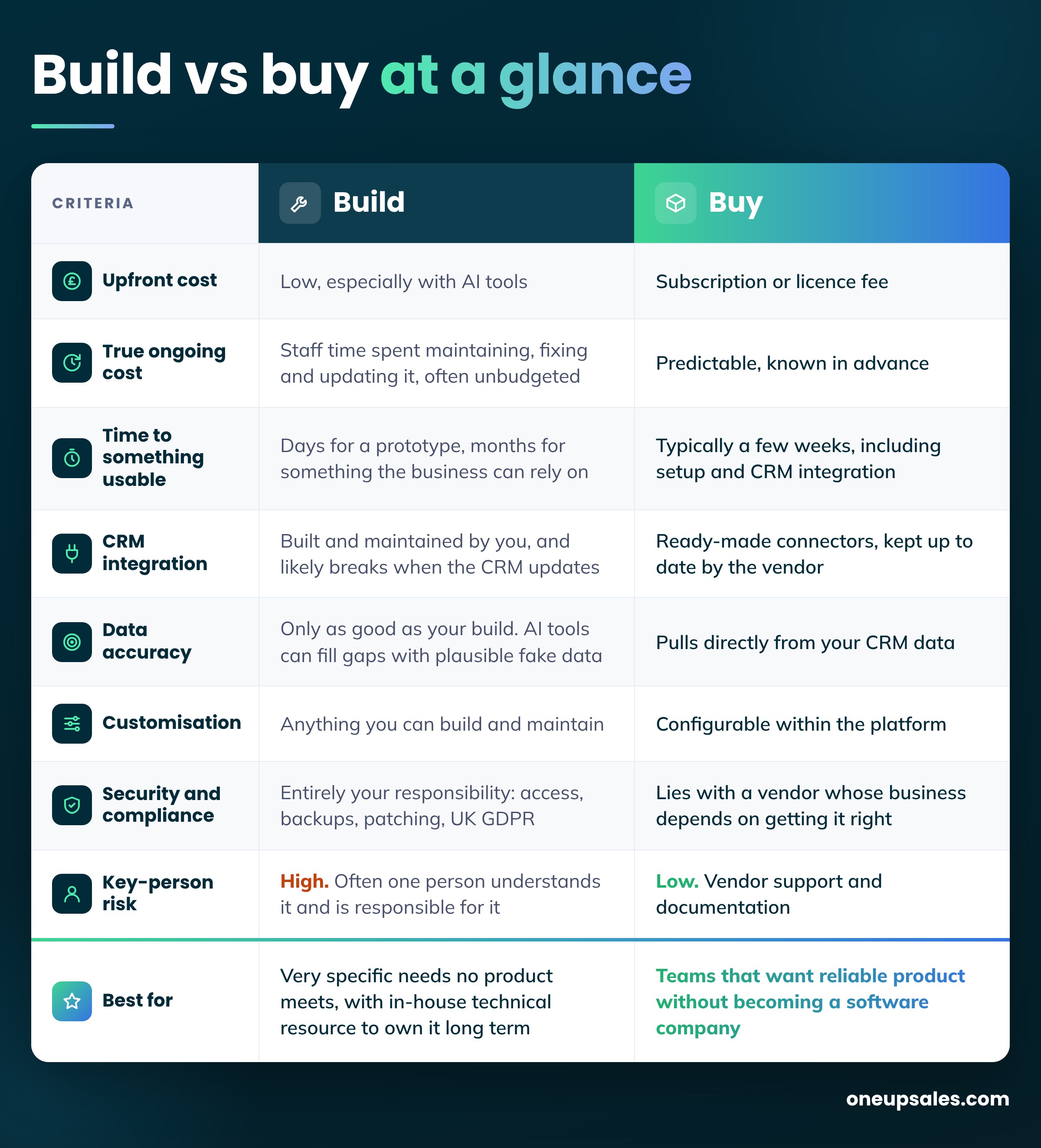
Build vs buy at a glance

Building your own tool and buying an off-the-shelf platform can both work. The difference is in where the cost, effort and risk end up. Here's how the two compare across the factors that matter most for recruitment teams.


build-vs-buy-at-a-glance (1)

When buying usually makes more sense

Buying is by far the least stressful option when it comes to your internal software choice. It’s tried, tested and reliable. Here are the headline reasons for when it makes most sense to buy.

  1. You're handling candidate or customer personal data.

  2. A tool already does something better than you could build.

  3. You'd depend on one person who understands it. And that knowledge is lost with them.

  4. It needs to scale, integrate with other systems and keep up with API changes.

  5. You want benchmarks and best practice, not just your own data.

When building can make sense

Building and maintaining your own software isn’t easy. But it can have its positives. If any of the below are true, then building your own software may make sense.


  1. The need is genuinely unique to your business.

  2. It's a low-risk internal task with no sensitive data.

  3. It's a small automation using tools you already pay for.


Often the best answer can be a mix of both options. Such as buying the foundations and building the extras.

For example, Aspire kept its CRM for process, candidate care and client management, and added OneUp to bring that data to life through reporting.

And one recruitment leader we spoke to is actively building with AI himself, but preferred formal software, like OneUp Analytics, which made more sense to his bottom line. It’s built by a dedicated professional team so he can focus his AI efforts on what's unique to his business.

How to decide whether to build or buy: 5 questions to ask yourself

  1. Is this core to how we succeed? Cloud strategists such as AWS's Gregor Hohpe argue the simple "build what differentiates you" rule isn't as straightforward as it sounds, and CIO notes organisations often overestimate how unique their requirements are.

  2. Does it touch personal data? If so, security and compliance could become a problem.

  3. Who owns it in 2 years? If the answer is one person, that's a risk. Is that risk worth taking?

  4. What will it really cost over 3 years? Include time, maintenance and any API charges. It’s often hard to even know this. Especially with fluctuating and rising costs.

  5. What else could that time be spent on? Compare cost and time invested in building and maintenance to time spent billing. Is it worth it?

The bottom line

You can build your own software, and for some needs you should.

Just go in with your eyes open about the security, maintenance and API costs that tend to arrive after the first version works.

If your need is a commodity, or involves sensitive data, buying usually gets you to value faster and with less risk. Teams that have already automated their reporting, like Ivory Group, tend to find the time they save goes back into the work only they can do.

Wondering how a bought platform sits alongside your existing CRM? Book a demo with our sales team

Image of Derry Holt
Derry Holt
I'm Derry, the CEO & co-founder of OneUp Sales (by day) and a professional video games commentator (by night). I have a background in software development, but if the last 7 years have shown me anything, it's that my passion truly lies in creating, building, and growing software companies.

“I like that can see everything all in one place. From my own targets, to activity from colleagues, to Team Leagues, everything is simple and easy to use.”

leona_mcphail
Leona McPhail
Head Resourcing

Similar posts