OUL Logo - Black

Your go-to hub for recruitment industry benchmarks.

 
Explore insights ➜
Top rated in all the right places G2 rating
G2 Badges Staggered Tiles

“OneUp has become indispensable, empowering our team leads to make data driven decisions.”

Richard F. 100px
Richard F.

CEO | ★★★★★

Product

Integrations

See all Integrations

Make performance visible, engaging and motivating. Book a demo products1

Resources

OUL Logo - Black

Your go-to hub for recruitment industry benchmarks.

 
Explore insights ➜

Company

Top rated in all the right places rating
award

“OneUp has become indispensable, empowering our team leads to make data driven decisions.”

Richard F. 100px
Richard F.

CEO | ★★★★★

Make performance visible, engaging and motivating. Book a demo

What Is Data-Driven Recruitment? A Practical Guide for Agencies

Data driven recruitment means running your desk on numbers, not gut feel. A practical guide to the metrics agencies should track and how to act on them.

Table of contents

Recruitment has always run on relationships, but agencies making progress are those backing up great relationships with data. This guide breaks down what data driven recruitment is, why it makes a big difference for agency performance, and how to build a process that gives your team accurate, real-time numbers without drowning them in admin.

What is data driven recruitment?

Data driven recruitment is when an agency uses measurable data, like time to fill, source of hire, and consultant activity, to guide their decisions and agency strategy, rather than relying on instinct or "gut feel" alone.

It means tracking what's happening across your pipeline and using those numbers to spot what's working, fix what isn't, and forecast what's next.

Data driven recruitment vs “gut feel”

Experience matters in recruitment, and it always will. A seasoned recruitment consultant's instinct for the right candidate is hard to manufacture quickly. That’s why your senior recruiters are typically your top performers.

But instinct alone can't tell you why one recruiter’s consistently hitting target while another’s missing it, or which activities will always convert to placements. Gut feel is reactive and hard to scale. You can’t give an entry-level recruiter the ability to use gut instinct without years in the job.

Data driven recruitment however can give you an objective, repeatable way to answer those questions, and it means decisions about training, targets, and process aren't based on whoever has the loudest or most time-served opinion in the room.

The role of recruitment data

Recruitment data plays a role at every level of your agency, not just for reporting to your leadership team.

At the recruiter level, it helps individual recruiters see where their pipeline’s leaking.

At the team level, it helps managers coach effectively and set realistic targets.

And at the leadership level, it turns forecasting and hiring decisions from guesswork into effective planning.

This matters more than ever given the pressure UK agencies are currently under. According to the Association of Professional Staffing Companies' Recruitment Index, UK recruitment firms are navigating a market defined by candidate shortages, margin pressure, and declining permanent placements.

These are conditions where the agencies with the clearest data on their performance are best placed to adapt. It's also why the Recruitment and Employment Confederation (REC) has published formal guidance on using data driven tools responsibly, reflecting how central data has become to how UK agencies operate.

What counts as recruitment data

Recruitment data covers more than placement numbers. Broadly, it includes:

  • Activity data: calls made, emails sent, meetings booked, CVs sent
  • Pipeline data: candidates submitted, interviews arranged, offers made
  • Outcome data: placements, fall-off rate, time to fill, time to hire
  • Financial data: fee income, margin, revenue per consultant
  • Candidate and client data: source of hire, client repeat business, candidate response rates

The benefits of data driven recruitment

Agencies that build a genuinely data driven process tend to see the benefit in a few consistent ways.

  • Faster, more informed decisions: spotting a declining metric early means you can act on it before it affects revenue, rather than finding out when it’s too late.
  • Better forecasting: accurate historical data makes it far easier to predict which recruiters, desks, sectors are likely to perform well.
  • Fairer, clearer performance management: managers can coach based on what the numbers show, rather than assumptions.
  • Improved candidate and client experience: data on response times and fall-off points helps agencies fix the parts of the process that are costing them placements.
  • A stronger competitive edge: CIPD's Resourcing and Talent Planning research shows employers who track resourcing data are better placed to control cost per hire and reduce the risk of a bad hire, which is exactly the value proposition agencies are selling to clients.

None of this happens automatically, it depends on how the data’s collected in the first place. And that’s an important stipulation to make in using data in your recruitment business.

How to build a data driven recruitment process

The biggest barrier to becoming data driven is usually in understanding how your data gets collected. Most agencies run several tools at once. Their CRM, their phone system, the job boards they use, if they use any, timesheets or hours for contractors, and maybe a separate marketing platform. This data can be left unconnected or in silos as individual sources. Often, the only way to get a full picture is for recruiters to manually pull numbers from each one into a spreadsheet. The process is slow, easy to put off, and prone to mistakes. And this means the "data driven" decisions built on the back of it are often based on already out-of-date numbers or data that’s wrong by the time anyone looks at them.

Building a genuinely data driven process means automating your collection, not just asking recruiters to try harder at manual reporting.

Decrease human error

The issue here is that when recruiters have to manually log activity into a CRM or copy numbers into a spreadsheet, mistakes are unavoidable.

One missed call log, or a wrongly categorised placement, means a spreadsheet formula will break and nobody will notice.

This happens because manual data isn’t necessarily a recruiter's actual job, or certainly the one they feel like they’re paid to do. They’re rarely incentivised to collect data, and even when they are, the accuracy of that data isn’t checked or managed.

It's simply admin that takes time away from calls, candidates, and clients, and is therefore the first thing to get rushed or skipped when the desk gets busy. Recruiters get paid for placements, not logging phone calls.

In our experience of working with recruitment agencies, CRM logging is often seen as a chore rather than part of the job. And when there's no immediate, visible benefit to a recruiter for logging accurately, the motivation to do so drops.

The result is patchy data that undermines the entire data driven process built on top of it.

A good solution to this is gamification. Gamification shouldn’t be viewed as a gimmick either, but a genuine fix for a data quality problem.

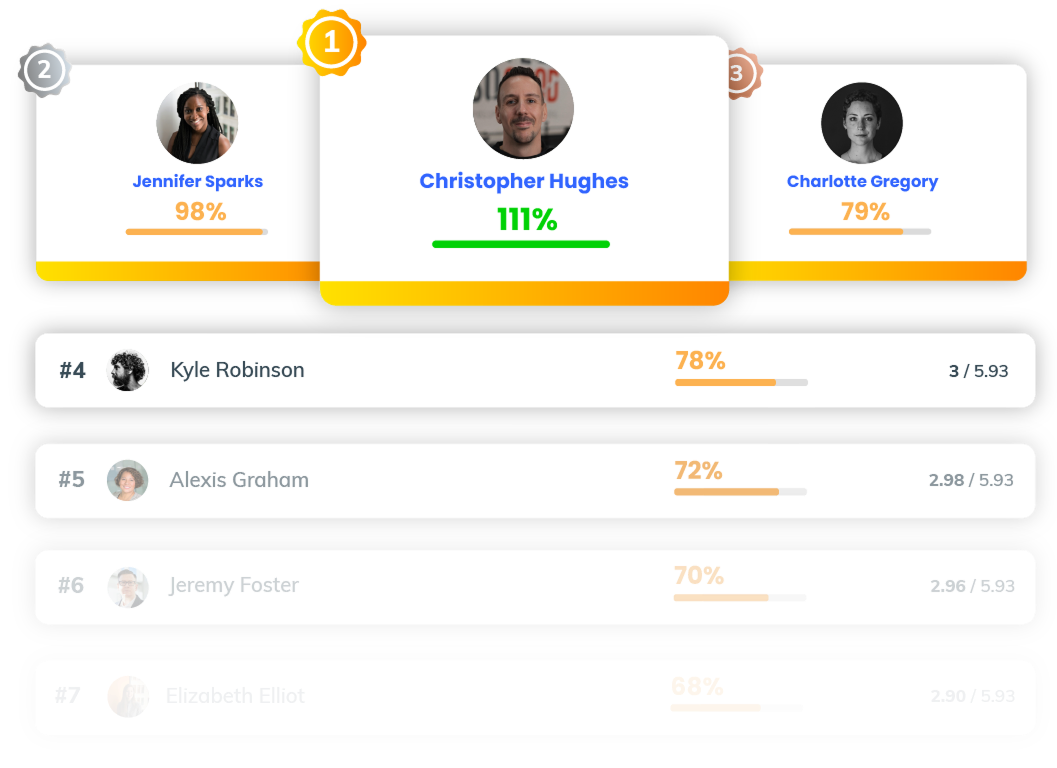
When activity that feeds your CRM also feeds a live leaderboard, a team competition, or a visible target, logging it stops being a chore and becomes something recruiters actually want to do, because they can see the immediate impact on their own standing.

We cover this in more detail in our guide to sales gamification, including how to design competitions that motivate accurate, consistent activity rather than just noise.

Keep track of your team's performance

Data driven recruitment is about being able to see how individuals are performing, how they compare to the rest of the team, and where coaching will have the most impact. A recruiter might be making plenty of calls but converting very few of them. They might be booking meetings galore that rarely turn into placements.

Without visibility at the individual level, that kind of pattern is easy to miss. Until it shows up in the end of month review obviously.

Real-time, individual-level reporting gives managers the ability to step in early.

Tools like OneUp's Coach are built specifically for this. It gives managers structured, data backed 1:1s so coaching conversations are grounded in a consultant’s activity, not a general impression of how they seem to be doing.

Save recruiters' time on admin

The less time your recruiters spend copying data between tools, the more time they have for the activity that actually drives placements.

Calls, meetings, and candidate conversations all drive revenue. Data collation doesn’t.

Automating data collection pulling activity straight from your CRM, phone system, and timesheets into a single live view removes the manual reporting work that eats into a recruiter's day.

It also means the numbers managers see are current, not a snapshot from whenever someone last updated a spreadsheet.

Recruitment metrics and KPIs

Once your data collection‘s automated, the next thing to work out is which numbers actually matter.

We go into far more depth on this in our Guide to Recruitment KPIs, but here are 7 of the metrics most agencies should be tracking as a starting point.

KPI

What it measures

Time to fill

Days from a role being opened to an offer being accepted

Time to hire

Days from a candidate entering your pipeline to being placed

Cost per hire

Total recruitment cost divided by the number of hires made

Placement rate

The percentage of candidates submitted that convert to a placement

Candidate response rate

How quickly and consistently candidates respond to outreach

Interview-to-offer ratio

The proportion of interviews that result in a job offer

Revenue per consultant

Fee income generated per recruiter, used to track individual and team productivity


How to measure the success of a data driven recruiting strategy

The success of a data driven strategy isn't measured by how much data you're collecting, but whether that data’s actually changing decisions and actions across your team.

Can a manager look at a dashboard right now and know, without asking anyone, which consultants need support this week and which desks are on track for target?

If the answer to that question is yes, your data driven strategy’s probably working.

If your leadership team’s still waiting on a manually built report to answer that question, there's a gap you need to address between having data and being data driven.

Recruitment data analytics: automating collection and reporting

The most reliable way to close that gap is to stop relying on manual reporting altogether.

OneUps recruitment dashboard software pulls data directly from your CRM, VoIP system, and timesheets into a single real-time view, so managers and leadership get an accurate, live picture of performance without recruiters needing to do any extra admin.

We pair this with custom dashboards for individuals, teams, and leadership, turning raw activity data into something every level of the business can actually act on, without anyone needing to build a spreadsheet.

What does ‘good’ look like?

Ivory Group, a specialist recruitment consultancy, is a good example of what this shift looks like in practice.

Before working with OneUp and the JobAdder integration, the agency relied on spreadsheets to track metrics and report on performance, a process that led to inefficiencies, inaccuracies, and no real-time visibility into how the business was performing.

Timesheet data from their payroll system also sat separately from their CRM, making accurate billing and margin tracking difficult, particularly for their temp recruitment division.

After implementing OneUp alongside their CRM, Ivory Group was able to pull timesheet, CRM, and performance data into one place automatically.

The result was more accurate data and better CRM compliance, less manual admin for consultants, and crucially, managers who could finally see individual and team performance in real time, rather than waiting on a spreadsheet to be updated.

As their Associate Director of Finance & Operations put it, the team is no longer "double handling the work", the metrics simply come through on a dashboard instead.

Data Driven Recruitment FAQs

What is data driven recruitment in simple terms?

Data driven recruitment means using measurable data, like time to fill, placement rates, and consultant activity, to guide hiring decisions and agency strategy, instead of relying purely on instinct or experience.

Why is data driven recruitment important for agencies?

It helps agencies spot problems earlier, forecast more accurately, coach consultants more fairly, and make the case to clients that their process is measurable and repeatable, not just a matter of luck or relationships.

What tools do agencies need for data driven recruitment?

At a minimum, most agencies need a CRM to capture candidate and client activity, plus a reporting or analytics layer that can pull data from the CRM, phone system, and timesheets into one automated view, removing the need for manual spreadsheet reporting.

How is data driven recruitment different from using an ATS or CRM alone?

A CRM or ATS stores the data, but doesn't automatically turn it into insight. Being data driven means actively using that stored data, through dashboards, reporting, and KPIs, to inform day-to-day decisions, rather than letting it sit unused in the system.

Is data driven recruitment only useful for large agencies?

No, smaller agencies often benefit the most, since they typically have less room for inefficiency. Even a small team can use basic KPIs like time to fill and placement rate to spot problems early and improve consistently.

Image of Devon Dalton
Devon Dalton

“I like that can see everything all in one place. From my own targets, to activity from colleagues, to Team Leagues, everything is simple and easy to use.”

leona_mcphail
Leona McPhail
Head Resourcing

Similar posts