













One-to-ones, performance reviews, appraisals, tête-à-têtes… whatever you call them, they're an inescapably necessary part of recruitment.
You could probably make a decent argument that one-to-ones are where recruitment performance improves. It's a chance to look back at the effort, input, outcomes and success or failures over the last period and readjust anything that didn't align with the ideal.
A chance to look at the numbers, and decide what happens next.
One of the troubles with performance reviews is that depending on the recruiter, manager or business, there could be one hundred different ways of doing them. And those all might be seen within one business over the course of the year.
We already know there's an epidemic of accidental managers in recruitment. Therefore, it's highly likely there's also an epidemic of accidental performance reviews.
One of my good friends, a lifelong recruiter described his first 5 years of monthly appraisals as this.
"Hit target this month? Yeah…? Great. Heard any decent new music lately? Arsenal are doing well. Alright, see you next month. Carry on smashing it."
It was a 30 minute in and out, and only hit the 30 minute mark, if indeed there was new music to discuss. If not, it was 10 minutes, because he always did well, and rarely needed, nor was offered, any kind of guidance.
Great if you're doing well. To a point, if not incredibly limiting on growth and ambition. Even less so if you're not. And plenty of his team never did very well.
Done badly, performance reviews become administrative theatre, where subjective, inconsistent, and quietly demotivating language perpetuates underperformance.
Done well, they're one of the highest ROI activities in a recruitment business.
They can improve billings, increase employee satisfaction and staff retention, and give wider business success a shot in the arm in a way that's measurable and repeatable.
Our guide below breaks down how to run one-to-ones that genuinely improve performance.
It's grounded in behavioural science, performance research, and details how modern recruitment businesses are reshaping what good looks like.
The way things were
Let's take a look at the history of performance reviews and how they've come to be widely different things depending on who's performing them.
Performance reviews have historically been shaped by industrialisation-era thinking. That is, standardisation, control, and top-down evaluation. The classic model or annual or quarterly reviews was built around three assumptions.
Assumptions that are almost certainly now deeply flawed:
- Performance can be accurately measured and remembered over long periods.
- Managers can objectively assess individuals without showing bias.
- Feedback delivered infrequently is actionable and improvable.
Research has repeatedly challenged these assumptions and shown them to be incorrect.
In fact, studies on the recency effect show that managers place a higher importance on recent events and in some cases completely forget earlier performance. This shows the value of data in guiding reviews. And equally, maintaining consistent reviews on a monthly basis, using performance data tools like OneUp.
Secondly, research from the world of organisational psychology, such as in Society for Human Resource Management, has shown how subjective reviews introduce bias, inconsistency, and disengagement. So, a far cry from improving employee engagement or retention.
Recruitment is an industry built on weekly and monthly targets, real-time pipelines, and constant behavioural inputs like calls, CVs sent, interviews arranged, and deals made.
And while the vast majority of recruitment agencies will assess performance on a monthly basis, I'd suggest the vast majority also do so annually. A decent question to ask would be…. does that make sense?
Dealing with underperformance
Underperformance is where most one-to-ones fail because managers approach it incorrectly.
The default instinct might be to focus on the outcomes and look at a lack of revenue on the board, or diminishing gross profit.
"You're behind on billings and your CV send-outs are low. Those two things are probably related."
The trouble with this approach is, outcome-based criticism rarely changes behaviour. At least for good anyway. It might change your under-performers coming into work at all, but that's not the aim.
It also doesn't address causation or get to the bottom of why certain behaviours are followed.
Coach from OneUp Sales goes beyond spotting correlation and helps managers to dig deeper and unearth the context behind behavioural patterns
Behavioural science suggests specific, observable actions are far more effective targets for improvement.
Research into performance improvement, including work derived from Behavioral Economics, shows people respond far better to controllable variables and breaking performance into leading indicators increases accountability.
This means clear, immediate feedback is a far better way of improving behaviour change.
In recruitment, this means shifting the conversation from:
- Revenue → Activities
- Results → Process
- Judgement → Diagnosis
A practical structure for underperformance one-to-ones
1. Start with data (always use data)
- Calls made
- CVs sent
- Interviews booked
- Deals progressed
2. Identify constraints
Where's the drop-off?
- High calls, low CVs = poor qualification
- High CVs, low interviews = weak candidate quality
- High interviews, low offers = client misalignment
3. Diagnose the behaviour behind the metric
And this is what most managers probably miss.
Instead of advising a recruiter works harder or spends longer on the phone, it could be something like the below…
"Your conversion from CV to interview is 12% vs the team average of 28%. Let's listen to how you're positioning candidates."
4. Co-create micro-plans
Research shows goal setting works best when individuals are involved in creating the solution.
So, to use the example above, an agreement on increasing their CV-to-interview conversion from 12% → 20% over 2 weeks, with dual input from the recruiter and the manager will create far better alignment than simply "get your numbers up by the next time we speak".
It will also probably highlight the reason the percentage is low to begin with, and set about a fact-finding mission, where there's no blame or finger-pointing, but just accountability between two driven individuals looking for a positive outcome.
It might mean looking at how candidate summaries are presented, shadowing top performer calls more closely or recording and reviewing 3 client conversations. But all done under the guide of improvement or performance, rather than simply spotting frailties.
5. Close with accountability and a timeframe
- When will this be reviewed?
- What does success look like, when we see it?
The key principle
Underperformance is nothing more than a process breakdown. Your one-to-ones for those not hitting target should feel less like a disciplinary meeting and more like a performance lab.
Rewarding success
Most managers, especially those in recruitment, might assume high performers need less attention than those not hitting the same heights. The data suggests the opposite however. Especially if you want those high performers to keep growing, continue enjoying their work and stay with the company.
And you do.
Top performers are often more responsive to recognition and more sensitive to fairness. But they're also far more likely to leave if they feel overlooked. And you already know they'll have suitors if they decide this is the case.
Research into motivation from Gallup shows employees who receive regular, meaningful recognition are significantly more engaged and productive. And they're far more likely to stay with the business longer, creating a better company as a result.
Great one-to-ones do with top performers deconstruct success, looking at what worked and which behaviours drove the outcome. They also codify best practice and turn individual success into team capability.
You can record calls, share frameworks and build playbooks that others in the team can use to improve their own performance.
High performers need a challenge, and they have to feel achievable, regardless of the amount of stretch in them.
Research on goal-setting theory shows goals should be specific and challenging, but still perceived as attainable. And success should be aligned with progression.
Top recruiters are obviously motivated by money, but they're also motivated by promotion pathways, leadership opportunities and ownership of clients, accounts or verticals.
Giving your top performers recognition means reinforcing the behaviours you want repeated.
The importance of data on performance
This is perhaps an obvious thing to say, coming from a company so obsessed with recruiters' data, but if your one-to-ones aren't driven by data, they're likely driven by opinion.
And that's where inconsistency and subjectivity creep in.
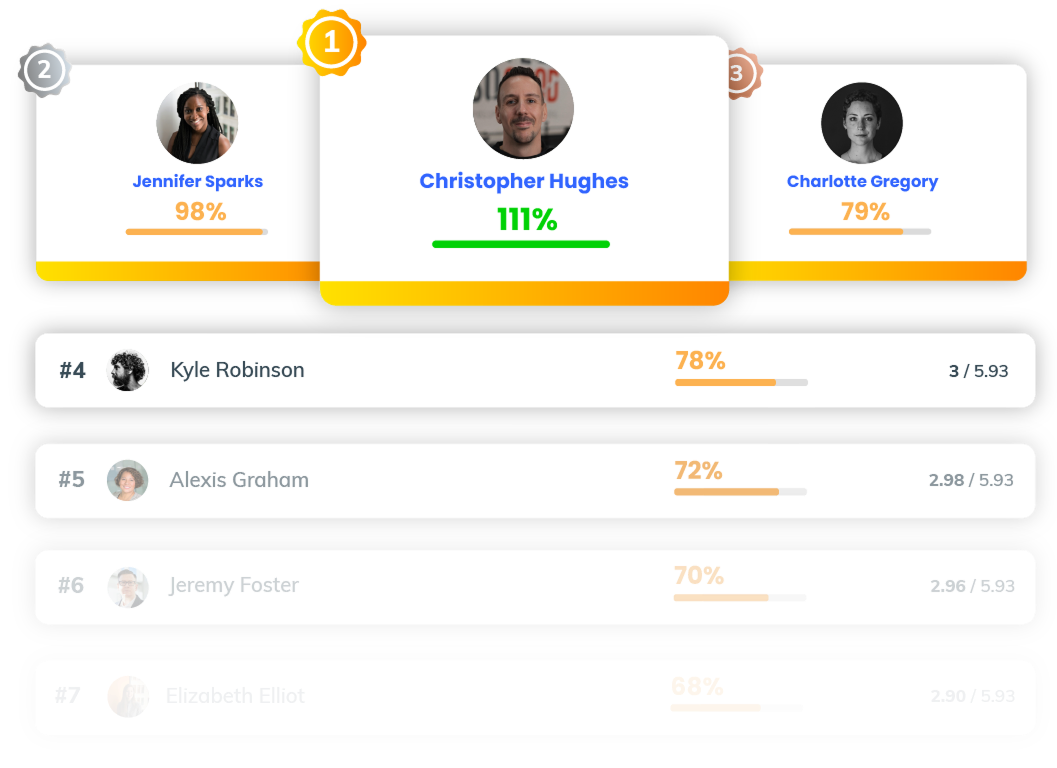
We built OneUp Sales entirely around this idea, by making performance visible, real-time, and actionable.
Data works, scientifically, because it reduces confirmation bias, or recency bias and increases fairness, while enabling self-regulation.
Studies into performance tracking show that simply making metrics visible can improve output, sometimes without any additional intervention.
What you should formalise (and what you shouldn't)
One of the hardest struggles in performance reviews is balancing consistency vs individuality. Too much structure will become robotic and disengaging. But too little will become inconsistent and unfair.
So what should you formalise?
The structure of the meeting's a good starting point. Every one-to-one should follow a consistent flow and include a review of data, a performance diagnosis, agreed actions and a set review point.
This will make sure you have fairness across your team and repeatable, clear actions and expectations.
You should also formalise the metrics used, naturally and the cadence. So everyone's measured against the same benchmark.
What you should think about making personal is the coaching style given to each individual. Because, well… they're individuals.
Different recruiters require different management styles and should be managed in a completely different way. Research into individual differences shows fairly severe variation in feedback sensitivity, motivational drivers and learning styles (as explored in our neurodiversity article recently).
While some might need direct, data-driven challenges, others are likely to respond better to collaborative problem-solving.
The depth of discussion is also something you might want to personalise. It's obvious a new recruiter may need tactical coaching, but a senior team leader will be put off by this to say the least and get far more from strategic discussion, like market positioning or deal strategy.
If in doubt, the basic principle is, standardise the system, but personalise the delivery.
Lessons from your competitors (Data from Coach & OneUp Sales)
Platforms like OneUp Sales and Coach give a useful lens into how modern recruitment teams are evolving performance management. Consistent patterns have emerged by looking into how these tools are used.
1. Visibility drives performance
Leaderboards, dashboards, and shared metrics increase output across the board. This is because people calibrate themselves against peers and competition (when healthy) increases effort.
Equally, transparency reduces ambiguity, which rarely produces great outcomes in sales teams.
2. Gamification works, but only when substance is attached.
Bad gamification can mean gimmicks or eye-rolling in teams, especially those senior in nature. But good gamification can create behaviour reinforcement and increase competition, and therefore results.
3. Coaching is moving from manager-led to data-led
The most effective teams use platforms like Coach to analyse calls, identify patterns and give targeted feedback, which reduces their reliance on the manager's instinct or anecdotal feedback.
4. The best teams treat performance as a system
Instead of assuming a certain recruiter is good or bad, they look at parts of their process which are either working or not. And then make actionable changes depending on that data-led insight.
This shift from individual judgement to system optimisation is where elite recruitment businesses separate themselves and has shown up in our clients again and again.
Final thought:
A good one-to-one is far more than a performance review or status update. And in most functioning recruitment businesses, it's certainly not a box-ticking exercise.
It's a monthly, or often weekly intervention where small behavioural changes compound into measurable commercial results.
If you get it right you'll find under-performers improve faster, top performers stay longer and your managers will become more consistent, meaning your revenue will become more predictable.
A good place to start? We've built a free weekly 1:1 tracker template that gives managers the structure they need to run consistent, data-informed one-to-ones. Check it out below.
Download our free weekly 1:1 tracker →
OneUp Coach
Want to remove admin from your appraisals and supercharge them with AI and live data?
Coach is our new 1:1 tool that helps managers prepare for reviews with metrics automatically synced from your CRM.
There's AI-generated manager briefings, saved notes, actions that carry forward, recurring agenda items and much, much more.